September 13, 2025
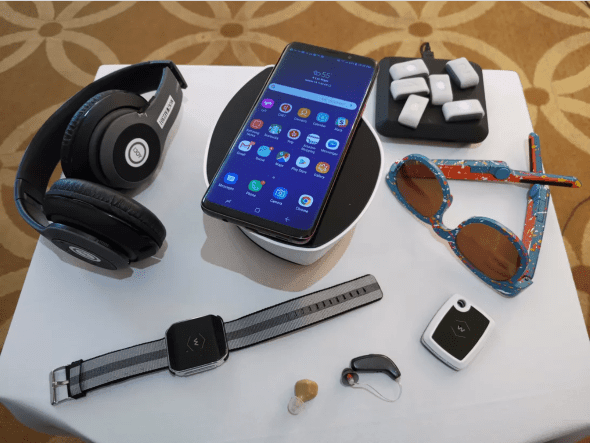
A power source like this can charge both your phone and smaller devices around it at the same time.
Imagine a world where your electronic devices charge themselves: a Bluetooth headset, a pair of hearing aids, a smartwatch on your wrist, even the phone in your pocket.
At the 2019 Consumer Electronics Show (CES), the dream of over-the-air (OTA) wireless charging became more realistic than ever with Wattup, a transceiver technology for remote charging. “This technology will be integrated into smartphones,” said Steve Rizzone, CEO of Energous – the company behind Wattup, currently a leader in the OTA charging field. Although the deals are in place, Energous has not yet revealed which phone manufacturers will use the technology due to the terms of the contract.
Last year when I spoke with Energous, the remote charging technology was just a concept. In 2019, the company actually had partners to create products, either pending or certified by the FCC (Federal Communications Commission).
Examples include the Delight hearing aid, the Deutsche Telekom wireless charging transmitter, and the Vuzix Blade smart glasses. Energous is also working on prototypes of a smartwatch with flexible antennas attached to its strap, a car remote control, and a pair of headphones, all of which are seen as stepping stones toward bringing over-the-air charging technology to phones and even laptops.
What these electronic devices have in common, apart from their compact size, is that they use relatively little power and have no flat surface. Traditional wireless charging – also known as inductive charging – where a phone or smartwatch is placed on a flat plate or pad, requires the device to physically contact a large, flat surface, from which magnetic wires can initiate the transfer of energy.
But small, curved devices like headphones and hearing aids can’t handle inductive charging. OTA wireless charging can transmit small amounts of power from a few inches to three feet away. It can also charge devices at all sorts of “weird” angles. Devices with small batteries can be fully charged in 30 minutes or an hour, even if they’re only transmitting milliwatts of power.
The OTA charger’s power source can also act as an inductive charger: you can place your phone on it to charge, or charge smaller devices remotely. The tiny 3x3mm silicon chip that does it all could be placed on the roof of a car, or on the bezel of a TV.
Energous is also working on technology to charge larger devices at higher power from a distance, but that’s still a long way off. A full-size device that can be charged from 15 feet away is on the roadmap by the end of 2020, Rizzone said at his lab at The Venetian. In the future, laptops could be charged this way, too.
“This technology has the potential to be as ubiquitous as Wi-Fi,” Rizzone said. “Users are looking for ways to eliminate the cord, or in other words, eliminate the need to find a wall outlet to charge.”
Energous rival Ossia is also planning to bring wireless charging technology to phones, starting with cases for existing models.
OTA charging also opens up an unexpected approach for the medical field. Being able to seal and wirelessly charge small medical devices makes them easier to sterilize and safer to use.
Now, as I walk down the crowded hallways at CES 2019, even though my phone still can't charge itself, I feel excited knowing that prospect is getting closer.
Source: https://www.cnet.com/news/over-the-air-wireless-charging-will-come-to-smartphones/